
A Thinker with a Pencil
The Phenomenon of Dilbek Tokhtakulov's Graphic Cosmos
There are artists whose skill immediately fascinates with its external intensity, yet the true scale of their talent is revealed only when a deep philosophical system is discovered behind their technical virtuosity. The graphic artist Dilbek Tokhtakulov is precisely such a case. Contemplating his monumental works created with a finely sharpened Italian pencil, sanguine, and sauce, one freezes in silence. In a world where the academic pencil is more often associated with intimate sketches, D. Tokhtakulov boldly moves toward a monumental scale—up to two and a half meters wide—proving that monochrome is capable of conveying the infinity of existence far brighter than any colorful palette.
Text by Anisa Polyanskaya
Photo courtesy of Dilbek Tokhtakulov
From the Radiance of Color to the Wholeness of Thought
D. Tokhtakulov's evolutionary path is dynamic and organic. His early works—vibrant with colored pencils, a bluish-emerald glow, and surreal cosmic themes—already bore the mark of a deep, twilight sadness and reflections on the fragility of existence.
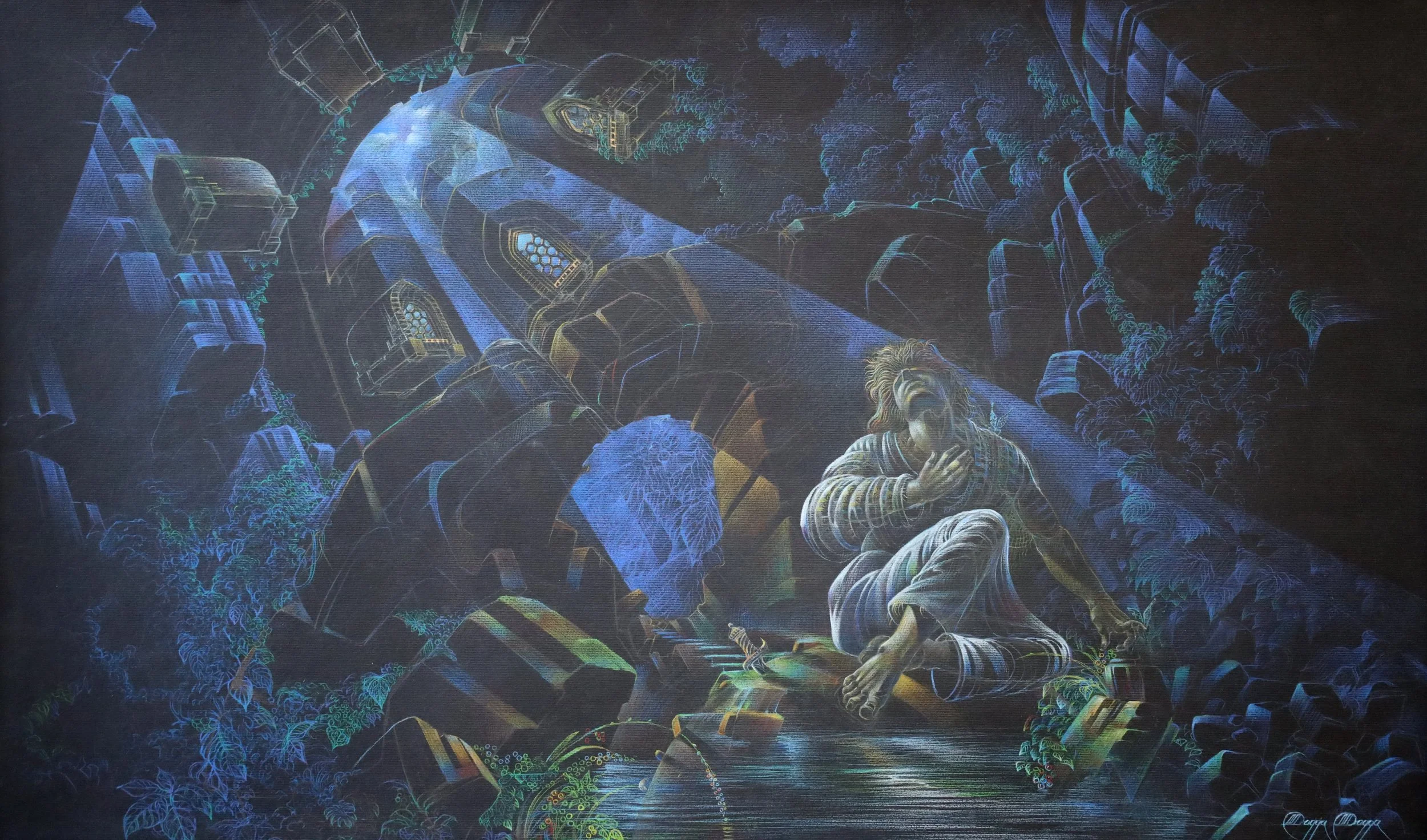
“Seven Planets”, 2020, paper, colored pencil, acrylic, 75 cm × 55 cm
However, behind this painterly quality, a need for a different, more concise and rigorous language was maturing. A turning point in this journey was the artist's personal meeting with master Viktor Apukhtin on September 11, 2023, during an en plein air session in the Botanical Garden. A trusting conversation and subsequent immersion in Apukhtin's printmaking—his etchings, linocuts, and lithographs—left an indelible impression on Tokhtakulov. Apukhtin's exhibition at the Academy of Arts became a fundamental school of thought for the young artist, showing the colossal philosophical power inherent in a pure line and a printed stroke.
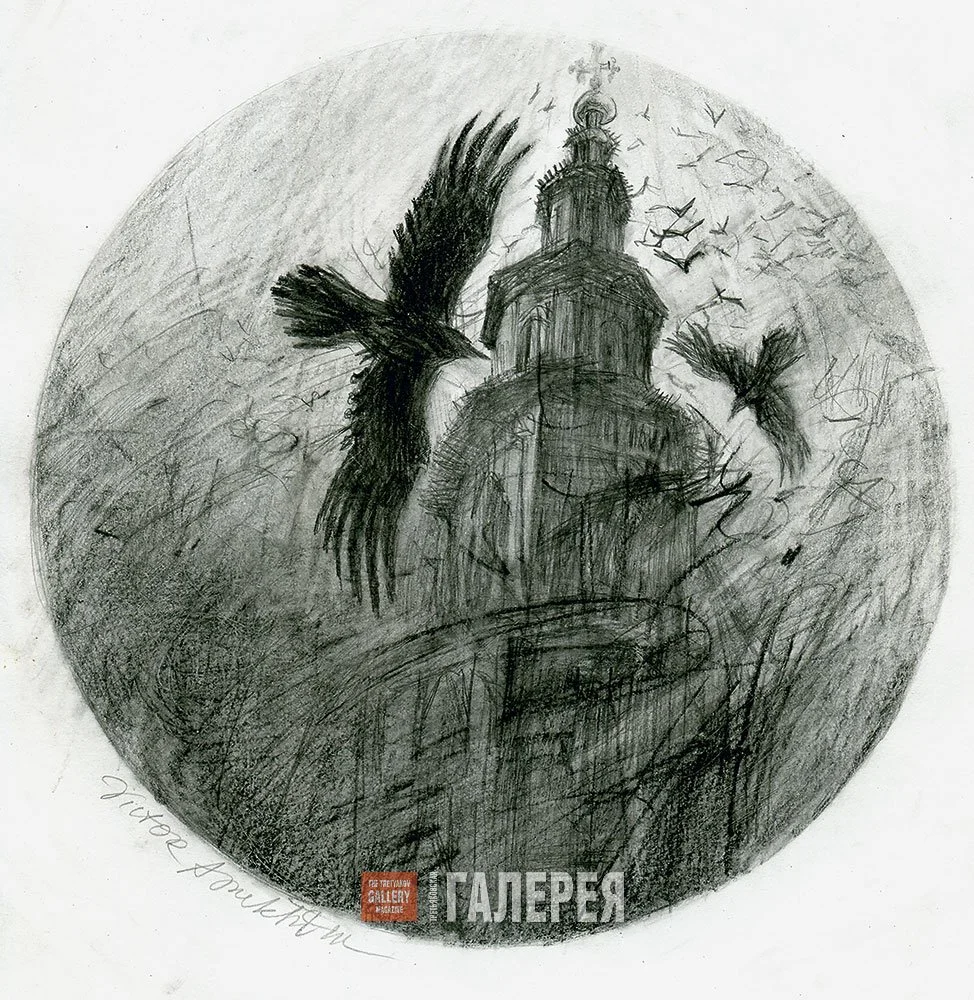
Viktor Apukhtin. “Evening Bells”, 2017, paper, colored pencil, 21 cm × 29 cm
It was this impulse that led Dilbek to a conscious step toward strict monochrome.
“An experimental transition to a monochrome technique serves to ensure that the idea and the form achieve absolute integrity, allowing the core thought to reach the viewer as accurately as possible and without distortion,” the artist himself explains.
Color "noise" often obscures true content from the eye. By stripping it away, D. Tokhtakulov has illuminated the architectonics of the spirit—a logical, well-thought-out, and rigorous structure of the human inner world. Just as a concise building in architecture rests on strict structural geometry, a clear and immutable structure of thought emerges behind the ultra-simple lines in his works. In the absence of color, the work relies on the pure plasticity of line and tonal rhythm, turning graphite into an instrument of profound philosophical expression.
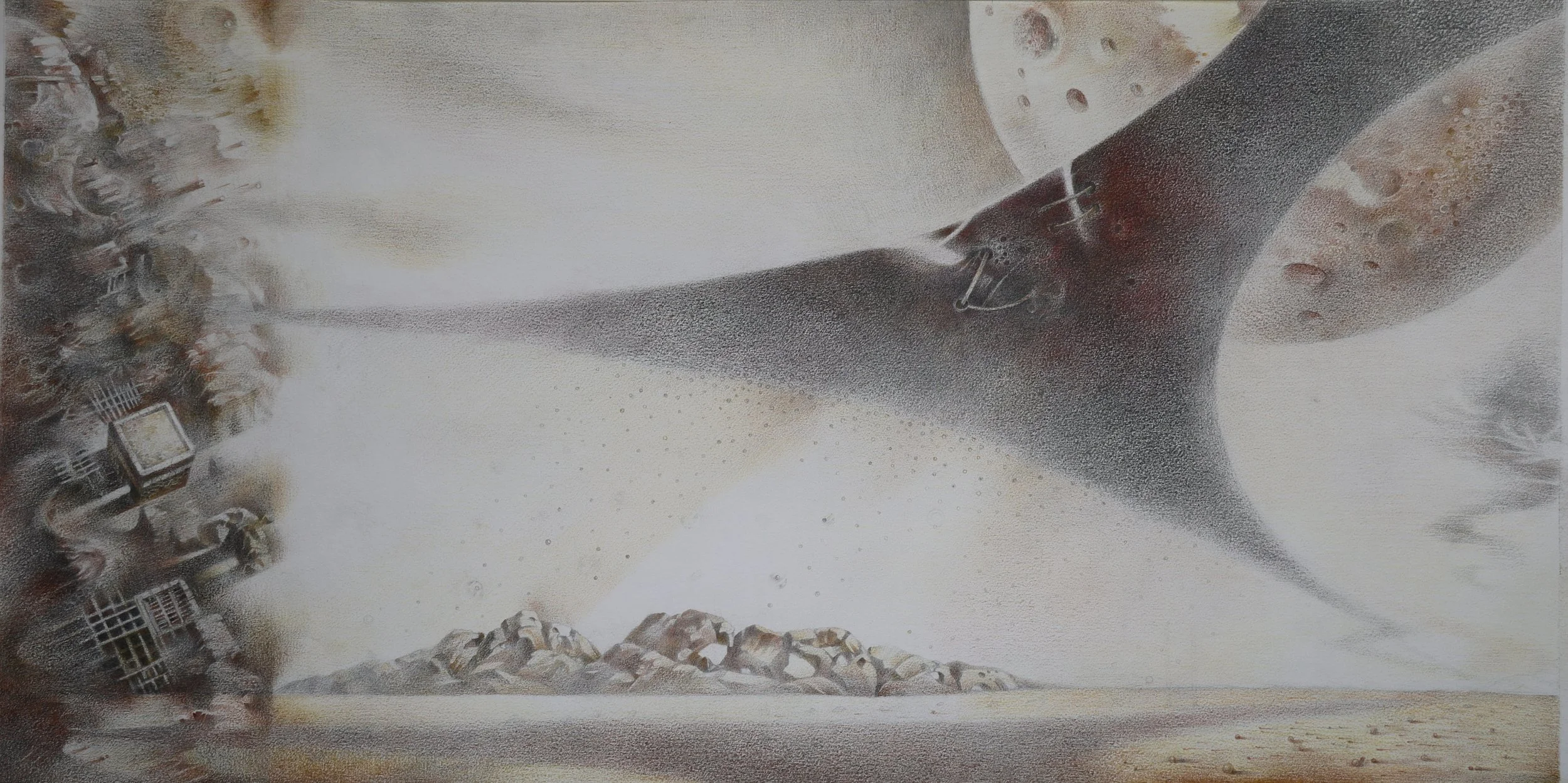
“Ababil”, 2026, paper, pencil, sanguine, 95 cm × 55 cm
Sufi Wisdom and Humanism: “We Are Fragile Bubbles in the Universe”
The phenomenon of Dilbek Tokhtakulov feels as if a Sufi thinker chose to become an artist by preference rather than chance. He deliberately picked up a pencil instead of a pen, as if subtly sensing that he could convey the full depth of his philosophy far better not by writing thoughts in lines, but by drawing their visual imagery. His works are imbued with the deepest humanism, referencing sacred texts and the spiritual quests of Eastern philosophy.
In the artwork “The Path of Barzakh”, the artist turns to Surah Al-Furqan, the name of which carries a fundamental meaning: according to the sacred text, Allah granted humanity the supreme capacity—Furqan, the discernment between good and evil, truth and falsehood.
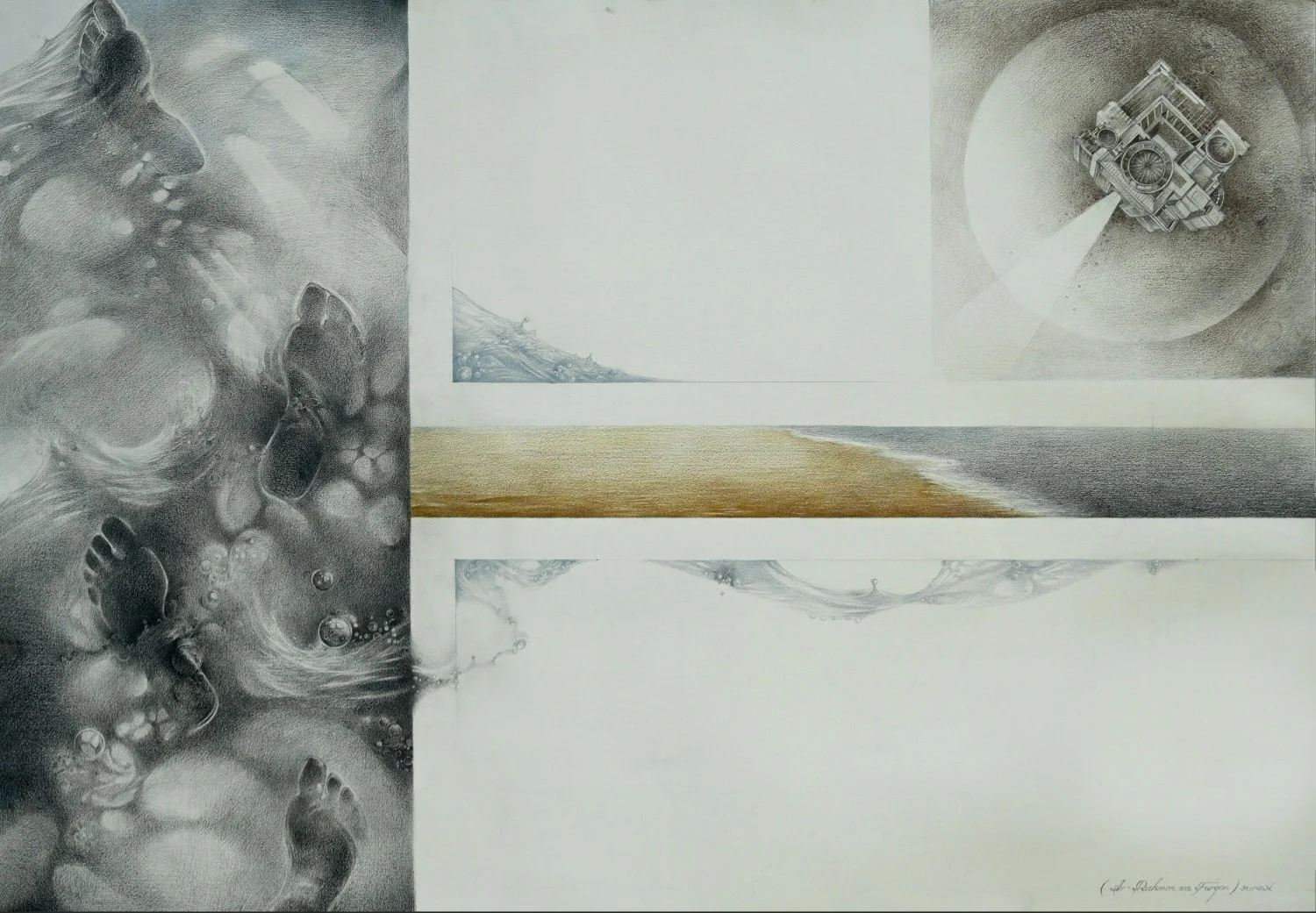
“The Path of Barzakh”, 2025, paper, pencil, sanguine, 105 cm × 75 cm
Journeying through life, a person daily faces the necessity of forging an inner Barzakh—that very boundary and invisible isthmus between good and evil. This line is not given to us from the outside once and for all; we establish it ourselves with every everyday and spiritual choice we make. And the main moral weight, the whole complexity of human existence, lies precisely in keeping this Barzakh in the right place, not letting darkness and cruelty wash away the bright shores of our soul, while remembering that someone from above is watching closely.
In D. Tokhtakulov's works, a human being is a grain, a speck of sand, a fragile soap bubble hovering over the abyss of time. This bubble can easily burst from human roughness and cruelty. But how can we ensure that there is less roughness and cruelty in the world? The artist's answer is clear: only by elevating culture—through the creation of goodness and a sensitive, careful attitude toward human beings. One cannot help but recall the writings of Nicholas Roerich: “Culture is the reverence of Light. Culture is the love of humanity. Culture is the weapon of Light. Culture is salvation. Culture is the engine. Culture is the heart. Civilization can be killed. But Culture, as a true spiritual value, is immortal.” Dilbek's works are a call to gentleness, to preserving humanity within oneself through internal enlightenment.
D. Tokhtakulov's graphics are rich in complex metaphors that the viewer piecing together like a puzzle:
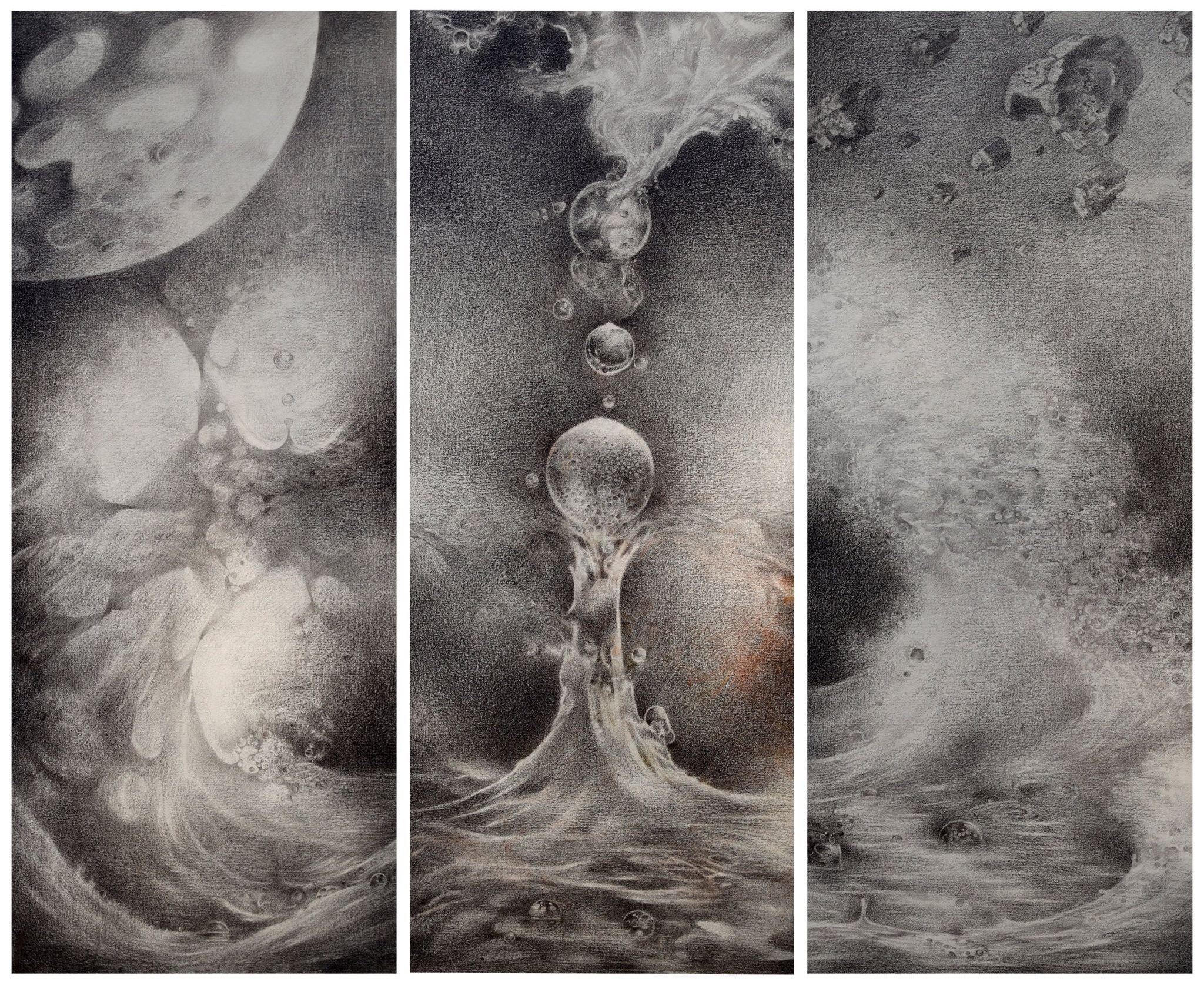
“Zam-Zam”, 2025, paper, Italian pencil, 113 cm × 81.5 cm
The Sacred Spring and the Energy of Water (“Zam-Zam”): The triptych draws us to the image of a sacred spring, generating a deep philosophical and cosmogonic metaphor. This is not merely a depiction of liquid, but a celebration of primordial, life-giving energy. Water appears here as sacred matter, a fundamental element from which everything living is woven and from which new life continuously springs forth. Hovering drops, splashes, and water spheres on D. Tokhtakulov's canvas embody the pure energy of existence: the human spirit and body are born from this life-giving moisture, and as we walk our earthly path and complete our physical cycle, we reconnect with this sacred primary element, dissolving into it and returning to the origins of the Universe.
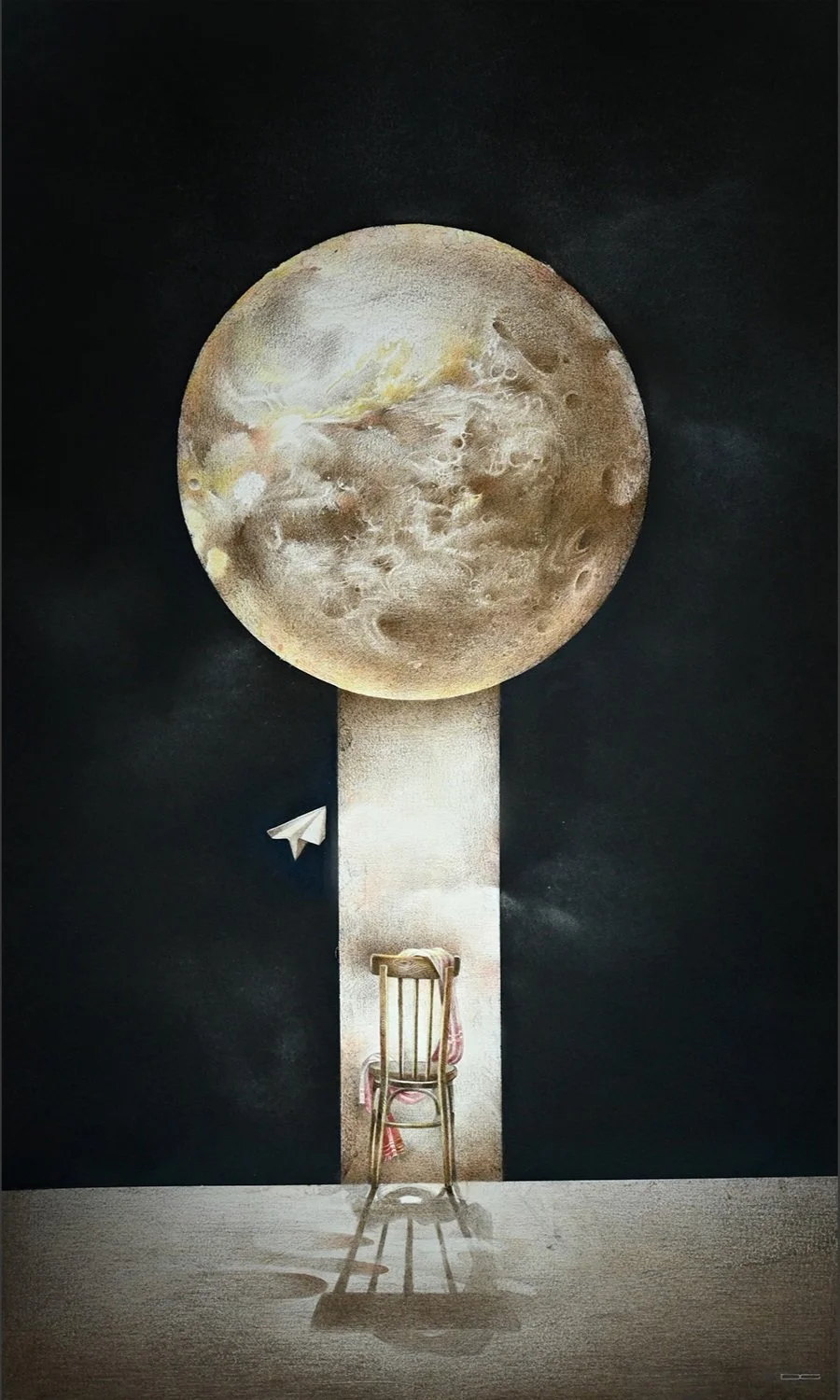
“The Little Prince”, 2025, paper, colored pencil, sanguine, 95 cm × 55 cm
The Planet, the Chair, and the White Paper Airplane (“The Little Prince”): The viewer's attention is instantly captured by a huge, stirring planet—an image of the Moon, whose phases and rhythms have governed the tides of oceans and the movements of human souls since ancient times. The complex texture of the celestial body, with its relief craters, surprisingly resembles raging waves on D. Tokhtakulov's canvas. This is a visual representation of the hero's restless inner element, living in constant awareness of the eternal struggle between good and evil. It is a metaphor for ethical anxiety itself, where it is vital to weed out the sprouts of evil and baobab-weeds in time before they tear the planet of the spirit apart. Yet, in the center of this cosmic drama, there is room for light: a small white paper airplane hovers straight toward the heart of the disc—a steadfast symbol of hope, a child's pure dream, and the swift flight of the human spirit.
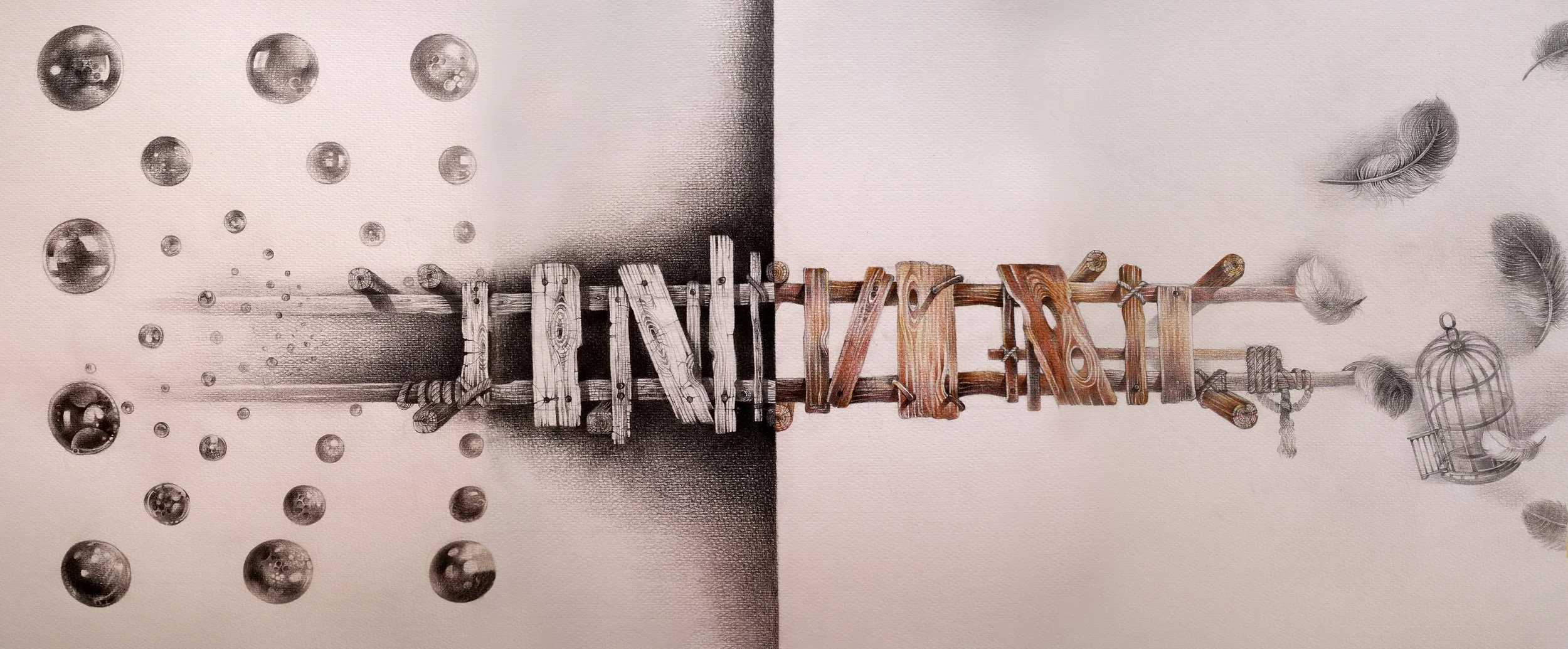
“Old Bridge”, 2026, paper, pencil, sanguine, 116 cm × 61 cm
The Cage, the Bird, and the Broken Bridge: A profound, dramatic reflection on freedom and boundaries. The cage is open, but where is the bird? Only floating feathers remain. Its earthly form has dissolved, while its spirit—finally attaining long-awaited liberation—flies somewhere infinitely distant and free, floating as weightlessly through space as these abandoned feathers. But now, it is on the other side of the canvas. All past life, memory, and experience have condensed into special sphere-bubbles drifting weightlessly through the Universe. Meanwhile, the frail wooden bridge serves as a connecting portal: it bridges the world of earthly illusions and material creations with the quiet, infinite expanse of pure spirit and floating particles.
Despite the impressive scale of his works, D. Tokhtakulov virtuously maintains balance: he is not afraid of "empty" space on paper. This pause in graphic artwork functions like silence in music, leaving space for the viewer's own thoughts.
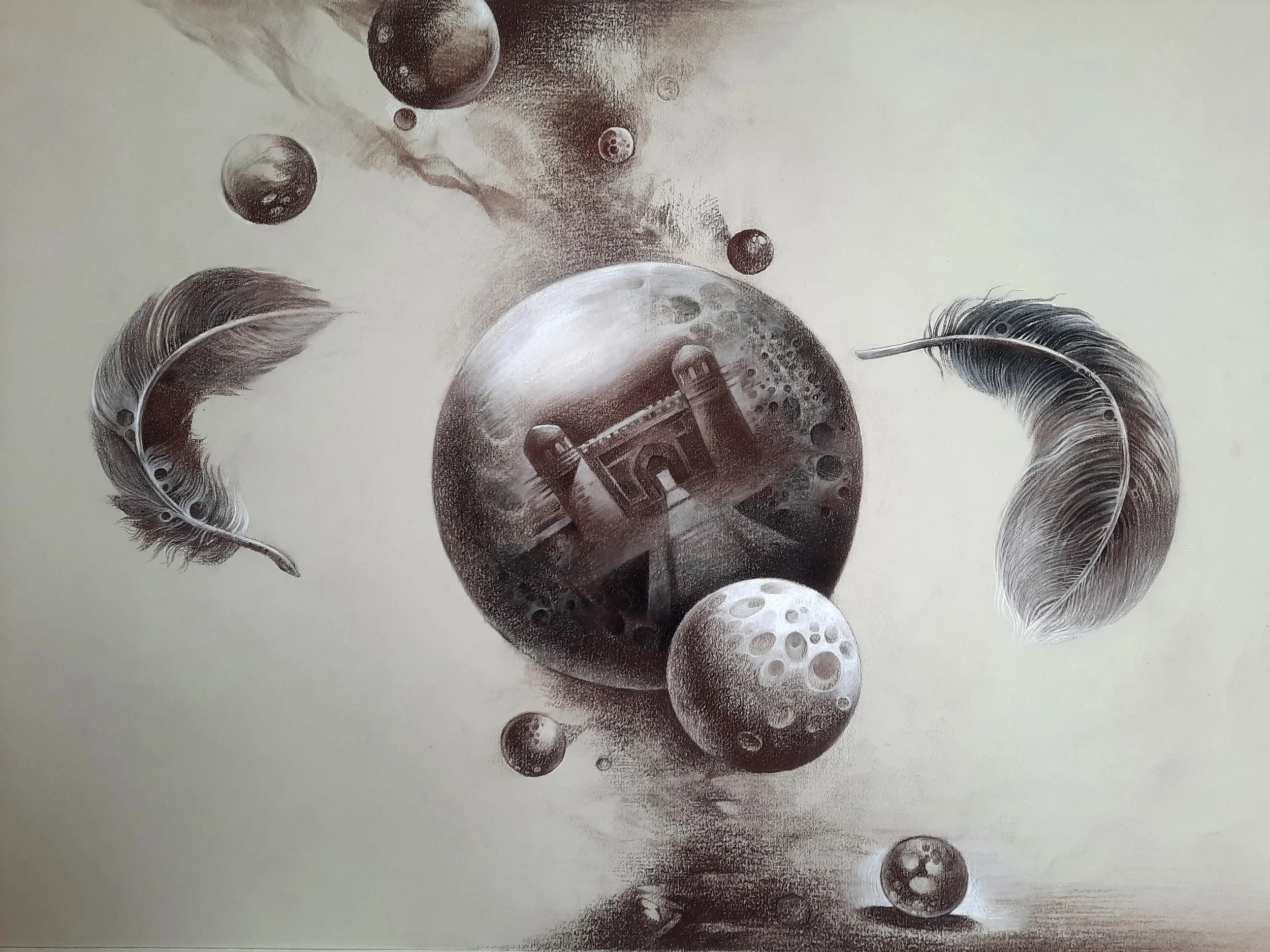
“Kokand Wind”, 2026, paper, pencil, sanguine, sauce, 85 cm × 55 cm
A True Gift: The Master's Humility
The personality of the artist himself deserves special attention. Amid the visual grandeur of his ideas, Dilbek Tokhtakulov strikes one in personal communication with his natural humility, intelligence, and complete lack of autobiographical self-admiration so often inherent in the creative environment. He continuously invests time in reading, studying art history, philosophy, and literature. This intellectuality, self-demanding nature, and capacity to accept criticism are a rare and precious gift feeding his growing talent.
Before us is a rising star and a rare type of thinker-artist in contemporary art, whose creative path should be followed with the utmost attention.