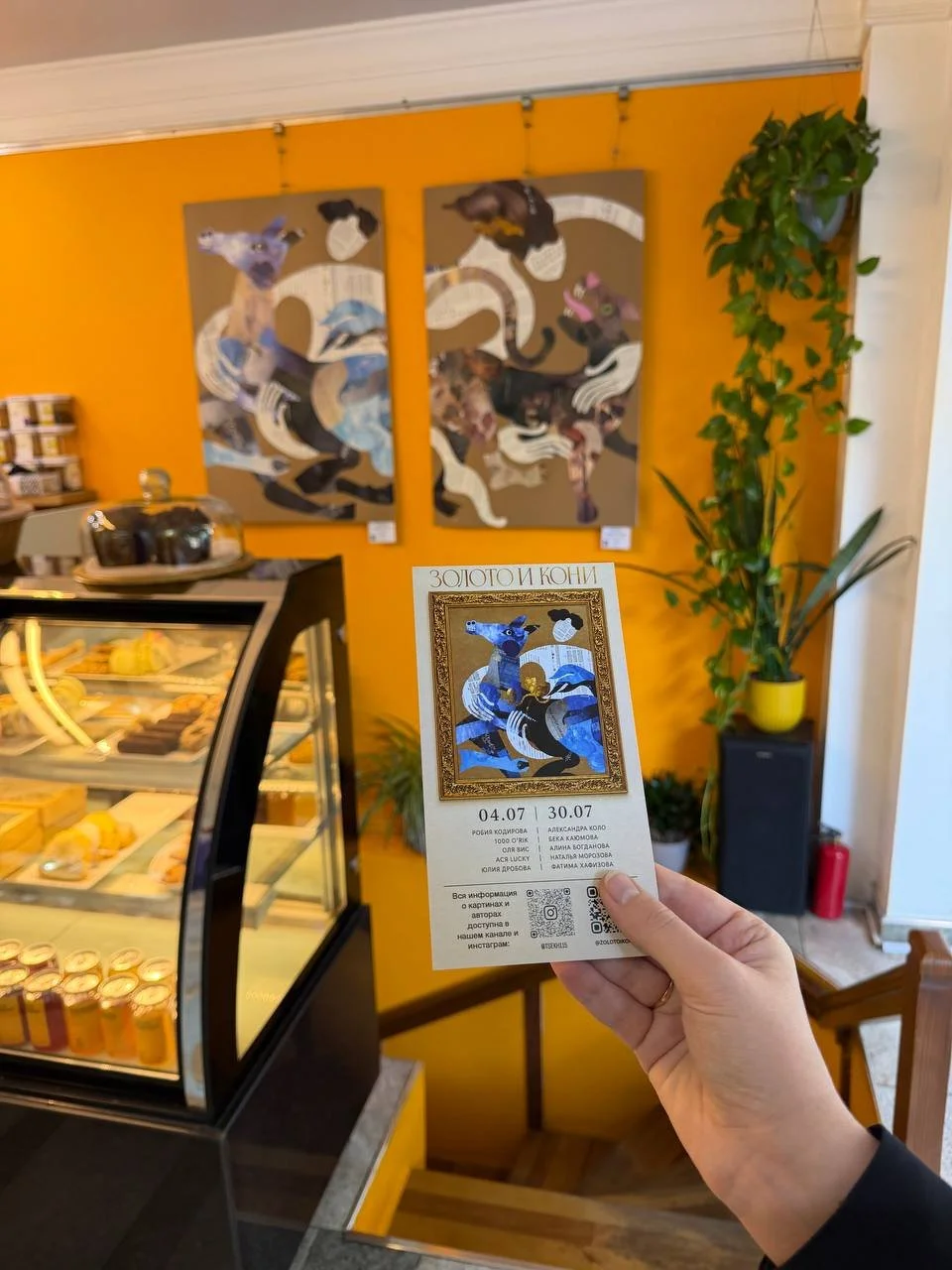
What happens when one of Central Asia's most recognizable cultural symbols is reimagined by a new generation of artists? Gold & Horses, a contemporary art exhibition by Workshop 115, transformed Coffee Nation into an unexpected gallery, where artists explored tradition, identity, freedom, and memory through one familiar image: the horse.
Text by: Kamila Serova
Few symbols hold as much significance in Central Asian culture as the horse. For centuries, it has represented strength, honor, freedom, and prosperity, accompanying people through everyday life as well as life's greatest milestones. Even today, presenting a horse as a gift remains one of the highest expressions of respect, reserved for distinguished guests and remarkable achievements.
Over time, images of horses displayed in ornate golden frames also became part of the region's visual language. Found in homes, offices, and public institutions, these paintings came to symbolize success, prestige, and status. They became instantly recognizable, carrying meanings that extended well beyond the artwork itself.
Rather than challenging this tradition, Gold & Horses invites viewers to see these familiar symbols from new perspectives. Each participating artist approaches the horse and the golden frame differently, transforming a shared cultural reference into deeply personal reflections on contemporary life.
Workshop 115: Art Beyond the Gallery
The exhibition was organized by Workshop 115, a newly formed collective of artists committed to making contemporary art more accessible. Bringing together painters, illustrators, architects, and multidisciplinary creators, the collective encourages collaboration while creating opportunities for artists to exhibit beyond traditional gallery spaces.
Presenting Gold & Horses at Coffee Nation perfectly reflected this vision. Instead of asking visitors to step into a museum or white-walled gallery, the exhibition brought contemporary art into a familiar community space, encouraging spontaneous encounters and conversations between artists and audiences.
Although united by a common theme, each of the ten artists interpreted it through their own artistic language.
Robiya Qodirova, whose work focuses on memory and identity, presents Memory I, where the horse is assembled from fragments of architectural forms and traditional ornamentation. The painting suggests that memory is never lost but continues to exist within the spaces, patterns, and cultural symbols that surround us.
Working under the artistic name 1000 O'rik, architect and collage artist Inna Safiullina offers one of the exhibition's most playful interpretations. Asking whether the horse itself wishes to become a ceremonial gift, she reconsiders familiar traditions while introducing the leopard as a symbol of feminine strength, independence, and resilience.
For Aleksandra Kolo, painting begins not with an image but with a thought. Her work frequently examines anxiety, vulnerability, and the internal conversations that define emotional experience. In Sugar Cube, the horse becomes a metaphor for confronting fear itself. Rather than avoiding what frightens us, the painting proposes that acknowledging fear, giving it shape and even a name can become the first step toward understanding and overcoming it.
Oil painter Beka Kayumova approaches the subject through movement, atmosphere, and light. Combining a realistic foundation with expressive Impressionist brushwork, she allows colour and texture to communicate emotion more powerfully than precise outlines. Her paintings Breath of Freedom and Before Dawn explore the horse as a symbol of inner independence. In one, a herd dissolves into luminous movement and energy; in the other, the quiet moments before sunrise become a meditation on hope, renewal, and the promise of a new beginning.
The exhibition itself originated with artist and illustrator Olya Vis, who envisioned bringing together different creative voices around one familiar cultural image. Her painting, Breaking Out of the Golden Frame, depicts a horse stepping beyond an ornate gilded border into an open landscape, becoming a metaphor for liberation from inherited ideas of status and success.
Ace Lucky brings another distinctive perspective to the exhibition. A graduate of the St. Petersburg Academy of Arts, she spent a decade restoring historic paintings before dedicating herself entirely to contemporary practice. Working in thematic series, her artistic language reflects both technical mastery and the freedom gained by moving beyond academic conventions. Her participation adds another layer to the exhibition's dialogue between tradition and contemporary expression.
Architect and contemporary artist Alina Bogdanova explores abstraction while questioning how value is assigned to works of art. Her paintings, stamped with the ironic phrase "Approved as a Gift for the Director," deliberately overflow luxurious gold frames, allowing paint to spill beyond their decorative boundaries. The works ask whether artistic significance lies within the artwork itself or in the prestigious symbols that often surround it.
Working across painting, collage, and animation, Fatima Hafisova explores emotional states that exist between reality and imagination. Her work Waiting for a Miracle celebrates hope, curiosity, and the quiet belief that extraordinary moments often begin within ourselves.
Born in Tashkent and now based in Berlin, illustrator Yulia Drobova has gained international recognition through her editorial and children's book illustration. Her acclaimed book Little Horses reflects a longstanding fascination with equine imagery, making her participation in Gold & Horses a natural continuation of an artistic dialogue she has pursued for years. Her presence also demonstrates how contemporary Uzbek artists continue to contribute to global visual culture while remaining connected to their roots.
Natalya Morozova explores the interplay of chance and control through cyanotype, a process that allows light, chemistry, and material to shape each final image. For Gold & Horses, she reflects on the culture of gift giving, questioning where sincere gestures end and unspoken rituals begin. Her work invites viewers to consider the delicate balance between tradition, symbolism, and personal meaning.
More than a group exhibition, Gold & Horses reflects a growing shift in Uzbekistan's contemporary art scene. By choosing a neighborhood café instead of a traditional gallery, Workshop 115 demonstrates that meaningful artistic experiences can emerge wherever communities gather.
The exhibition will remain on view at Coffee Nation through 30 July, and every Tuesday visitors will have the opportunity to meet participating artists, learn more about their creative processes, and engage in informal conversations about the ideas behind their works. By opening both the exhibition and the conversation to the public, Workshop 115 offers a glimpse of a more accessible and community-driven future for contemporary art in Uzbekistan.