Finding Khiva’s Heart
A guide's love letter to the only intact medieval city in Central Asia
Text by Mavlyuda Baltaeva
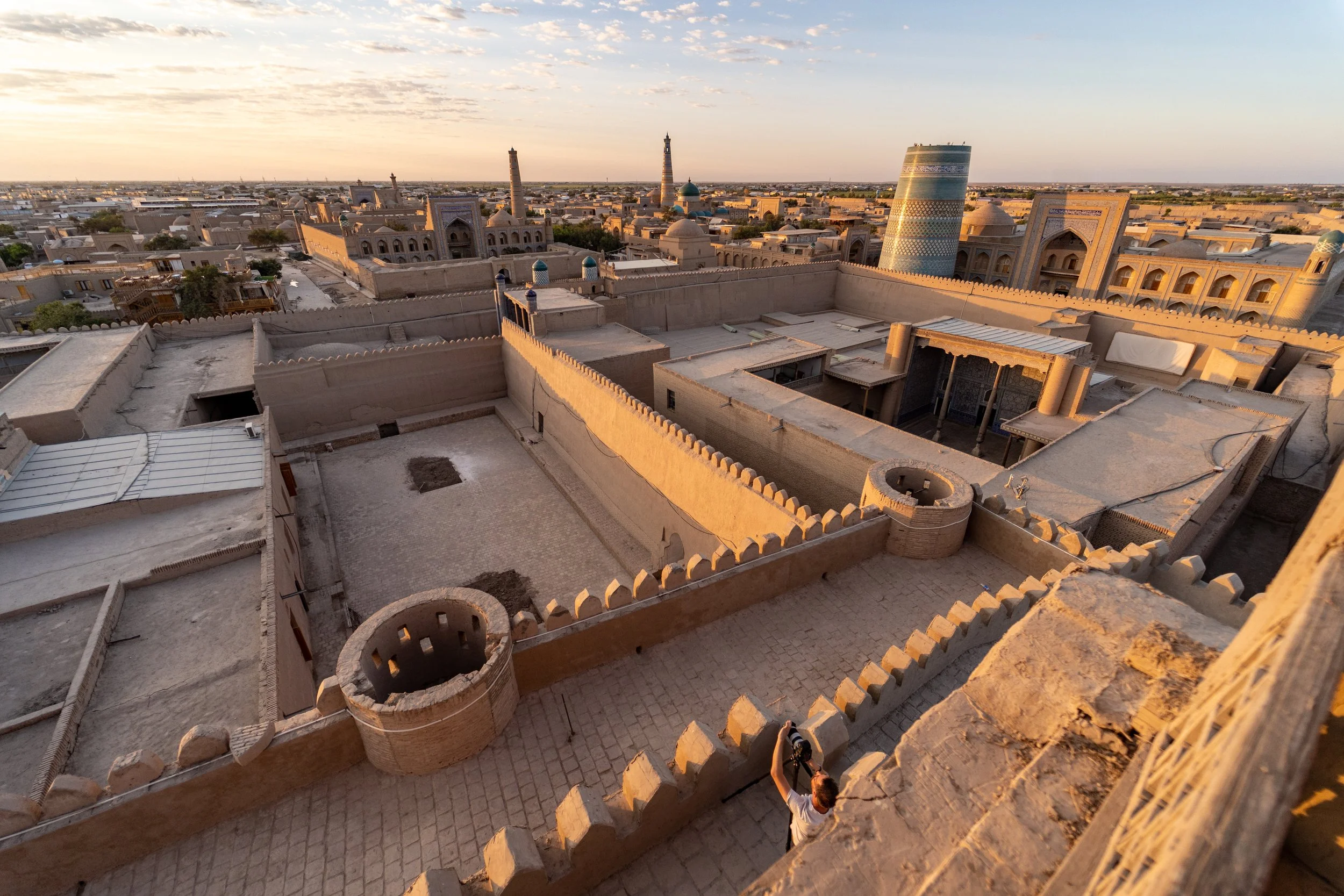
Khiva—more precisely, its historic heart, the Ichan-Qala—is a monument to architecture and history unlike any other in Uzbekistan or, indeed, across the East. It is the only city in the country that has survived completely intact as a medieval ensemble, still surrounded by its formidable fortress walls. When you approach those walls, time itself seems to slow, and the modern world feels suddenly, blessedly distant.
A City Built on Legend
The history of Khiva reaches back more than 2,500 years into deep antiquity. According to one legend, the city was founded around a well dug by Shem, the son of the biblical Noah. The water was extraordinarily sweet, and it was this very spot that became the magnet for the first settlement. From those modest beginnings, Khiva grew from a small oasis into one of the most important trading, cultural, and political centers of Khorezm.
Step through the gates of the Ichan-Qala's fortress walls and you are transported, quite literally, into a medieval world. Narrow lanes, clay-built houses, majestic madrassas, and soaring minarets create the impression of a film set, except this city is neither a replica nor a reconstruction. It is entirely, extraordinarily real. For centuries, caravans on the Great Silk Road passed through these very streets, carrying silk, spices, porcelain, and ideas that connected East and West.
Inside the Fortress
Within the walls awaits a fairy-tale city of the ancient East. Here stand the palaces of Khiva's khans—simultaneously lavish and austere—alongside harems, reception halls where the fate of the state was decided, bustling trading rows, and dozens of minarets. Each has its own character, its own story.
One of Khiva's most recognizable symbols is the unfinished Kalta Minor minaret, striking in its proportions and brilliant tilework. Legends and mysteries surround it, and visitors never fail to ask. Meanwhile, rising above the city is the tallest minaret in all of Uzbekistan—the Islam Khoja minaret, from whose summit unfolds a breathtaking panorama of the entire city.
But Khiva is far more than its famous landmarks. Hidden from the main tourist flow are countless "unremarkable" sites that reveal a different, quieter side of the city. The baths of Anush-Khan, for instance, are modest from the outside yet possess an astonishing history and unique architecture. It is precisely these places that allow you to feel the real, unstaged Khiva and understand how its people lived centuries ago.
How to Experience Khiva
Khiva can be experienced in many ways: a quick overview tour of one and a half to two hours for those with limited time; a more in-depth standard tour of five to six hours; or an entire day spent wandering unhurriedly through lanes, peering into courtyards, and listening to the legends, myths, and true stories that saturate every corner of the Ichan-Qala.
“I am sincerely in love with Khiva, and each time I try to share that love with my visitors. Perhaps the best proof that I succeed is when people return, this time bringing family and friends with them.”
Nurullabay Palace: Where Two Worlds Meet
One place in Khiva deserves special attention: the Nurullabay Palace, one of the most unusual and most recent of the Khivan khans' residences. It was built in the second half of the 19th century on the orders of the great khan Feruz Khan for his beloved son and heir, the future Isfandiyar Khan. Unlike earlier palaces located within the Ichan-Qala, Nurullabay was constructed in a new era, when the Khanate of Khiva existed under the protectorate of imperial Russia. That historical circumstance made the palace truly unique.
The architecture of Nurullabay is a rare and harmonious union of East and West. Traditional Eastern forms, including the eyvan and various decorative elements, blend with European planning, stucco molding, tall windows and doors, and bright, airy halls. The palace reflects a pivotal moment in Khiva's history: a time when ancient traditions coexisted with the influence of new European culture.
In the early 20th century, part of the palace was completed by Isfandiyar Khan himself. It was then that Nurullabay acquired its truly luxurious appearance. The khan brought approximately four kilograms of gold leaf from Russia to adorn the palace interiors. Ceilings gleamed with rich decoration and, according to tradition, were inlaid with large diamonds. A particular symbol of ties with the Russian Empire came in the form of three crystal chandeliers—a personal gift from Emperor Nicholas II.
Today, the Nurullabay Palace astonishes not only with its beauty but with its history. It is a place where you can feel, especially vividly, the meeting of two worlds, two cultures, two eras, all leaving their mark on Khiva's fate.